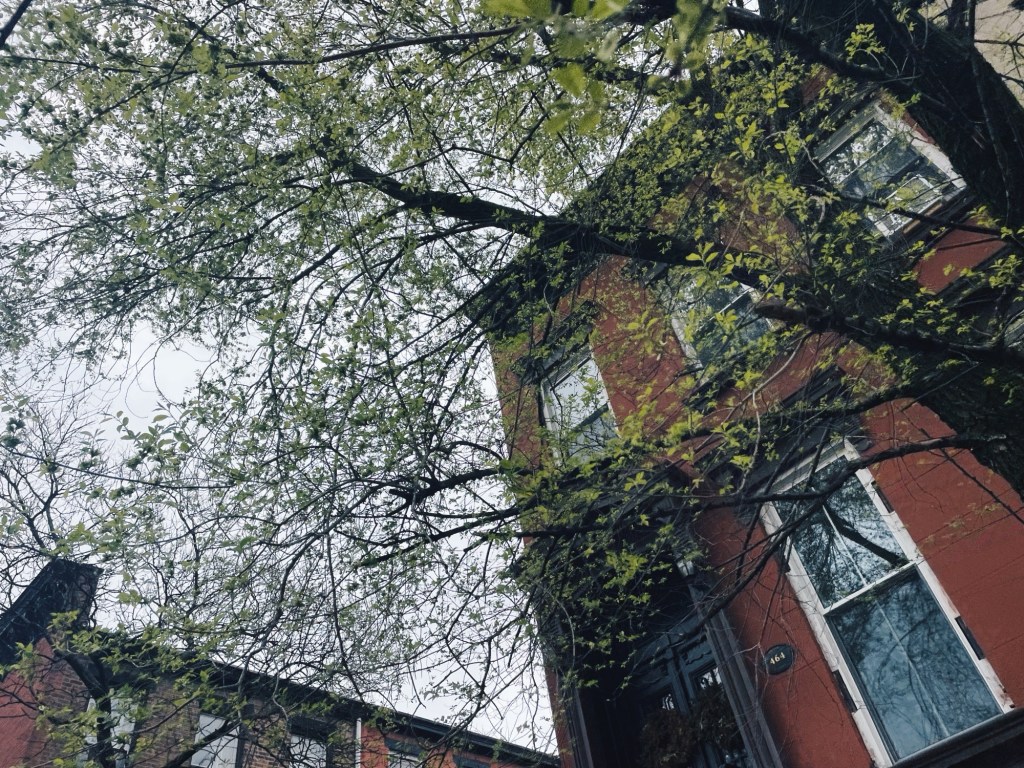
Lime green leaves have appeared overnight in Brooklyn.
Candy red and bubblegum pink tulips are screaming up and out of the earth on every corner and I am a kid, seeing it all for the first time.
I’ve been sitting by the open windows, watching green materialize, and reading. Shocker.
MORE ON TIM O’BRIEN
On a Tim O’Brien kick, I haven’t been able to put If I Die in a Combat Zone: Box Me Up and Ship Me Home down all week. Similar to The Things They Carried, it is a memoir he wrote about his year serving in Vietnam in 1968. Where the latter delves into aching extrapolations of memory as they came to him twenty years later, the former was written just a few years after the war. It’s a raw account of the war zone that was under his feet, but really, about the one he was fighting in his own mind. Philosophical dissections of courage, bravery, masculinity, and morality are woven all throughout the text.
Needless to say, I’ve been reading a lot about Vietnam in 1968. About Hanoi, Ho Chi Minh, and Diem. My Lai and the Tet Offensive. And as I read these terms, as I remember what they mean, I hear one of my old professor’s voices. Like the music at a party when you are in another room, his lectures are coming back to me, muffled, distant, yet audible. I can hear them still. I can feel the immensity that room, and how strange it felt to be there.
HISTORY CLASSES
My second year of college, I signed up for a course on The Vietnam War. It was an upper division history course and I didn’t need to take it. I already had the credit from AP courses and I was an English major. But I missed history. I missed it and I knew that this might be my last chance. I remember I had wanted to take the one on World War II, but when it didn’t fit my schedule, I anxiously chose Vietnam. Anxiously because all throughout my history classes up until that point, The Vietnam War had never been well taught. At least, I never understood it.
So the thought of taking this upper division college course on the one war that I could barely tell you anything about, was daunting. I did it anyway. I remember walking into that room on that first day and feeling small. Physically small. I was surrounded by a sea of guys. Older, history major guys. As an English study, I was used to small classrooms filled with mostly girls. I felt like I had just walked into a football locker room. I was a sophomore with lipgloss and and Sylvia Plath in her bag and I could not have felt more out of place. I was scared of the workload and scared of the topic and scared that I wouldn’t understand anything. But something held me. Something kept me there.
BEFORE
As the weeks unfolded, every fear dissolved out of me. My professor was not some high school history teacher, rushing over the Vietnam unit because he ran out of time. He was a brilliant author who spent every summer in Vietnam, studying the archives. When I checked out his book for the course from the library, I remember the librarian telling me that I was lucky to be taking his class. He was just one of those professors who really cared. This was his life’s work and the passion of that came through every syllable he uttered. I can still hear his voice, booming and enraged.
I was nineteen and still new to college. Still new to the place that I would spend the next few years learning like the back of my hand, not yet knowing that it would all come to feel like just one moment. Maybe that’s why I remember it so clearly. You remember beginnings. You remember the before, and this was one of mine. Before I gained my footing in adulthood, before going to New York, before learning that I was capable of a lot more than a big, scary history class. This was me, sitting up in the library, writing out term papers on Nixon and Vietnamization, forgetting entirely how hesitant I had been to take the course. I was fully absorbed.
There’s something intoxicating about finally understanding something that you felt you never knew anything about. Something so intoxicating that it changed me that semester. I started speaking up, asking questions. By the end of college I could never shut up in my classes, but I forget that it used to be so daunting. To raise your hand and test out the words on your tongue. I forget that it was in that sweaty room full of history major jocks and their louder-than-mine voices that I found my confidence within upper academia. I aced the course all the way through.
THE ONGOING CALCIFICATION OF YOUR LIFE
I haven’t thought about any of this in years. But reading this book, reading this war, I’m remembering it now. Which is making me remember everything. I’m recalling those years like dreams, yanking them back within grasp when they are only ever falling further from it. How is it possible that within just a few months, and just a few thousand miles, a place I was so completely entrenched in for years has become this ethereal memory? It’s all so warm and hazy and drenched in hues of honey when I think about it now. Walking around with a bag full of books and an iced coffee and nearly getting run over by frat boys on skateboards. Sitting in uncomfortable chairs and learning about girlhood studies, gothic literature, and war. World religions, Plato, and Zadie Smith. I am nineteen, twenty, twenty-one. Bright-eyed, in love, and then on my way out, my feet displacing the world beneath me without my permission. I miss it without wanting to return.
I am far from all of that now. I am drinking wine and hanging art on my walls in Brooklyn. College has been calcified. It has, like everything else, been turned to a stone in the palm of my hand. Nostalgia had rounded out it’s edges, rendering it smooth, glossy. I run my hands over it and see my reflection in the polished surface. A reflection that reminds me how sometimes we can only clearly see who we have become by looking back into where we have been.
Maybe it’s more like a body of water in that way. Don’t memories always feel like that? Like being underwater? Everything is blurry, in slow motion, and muffled. When you dive into a memory you dive deep under the dynamic waves of this moment and down into a space where everything is still. It all plays out before you, always more peaceful in memory than it ever really was. You can only hold your breath for so long. You can only withstand the pressure for so many feet. Being there always hurts just a little, always makes your chest feel like it might explode. You always have to come back. You have to break through the surface and take that gasping breath and leave all of that stuff down there as you heave for air. But we’re always diving back down. We’re always stealing those moments back, the ones that time has rendered so sweet and melancholic and almost forgotten.
I remember learning that our minds our perpetually pruning away memories. If we don’t touch them for long enough, they are severed from us, clearing up space for new information. I’m convinced that writing makes hoarders out of all of us. For even just in the time I have spent writing this, I am remembering things, little details like what I wore and what I was reading and what I thought about that semester, that I know would otherwise be pruned out of my consciousness.
I think that writing catalyzes the calcification process in that way, cementing what would otherwise fall through your hands like water.
Click here to support a small artist with big dreams (me)
ABOUT SPINNING VISIONS
A space dedicated to documenting experience and exploring thought. Click here to read more.
GET ON THE LIST
Give your inbox something to look forward to.
 SPiNNiNG ViSiONS
Leave a reply to I Don’t Want To Go Home – 18th September 2024 – 1994ever Cancel reply