
They are not lying when they say that your life will begin to feel like a dream in this city.
Somewhere among the subway rats and heaps of trash and lethal August heat, you notice yourself growing increasingly stuck to the web that is New York.
SPIRITS PASSING THROUGH
You arrive innocently enough. You take that first breath of city air and inhale a kind of premonition. A vision. A spinning vision, if I ever saw one. You see life for all that it could be and all that it might be, stretched out before you like the yellow brick road. There is no place like home. I closed my eyes and clicked my heels for a very long time to get here. I lost many hours of sleep and left a lot behind and took an absurd amount of risk, but I did get here. About seven months ago now, if that is even possible. And it became home. It became everything. It all began.
Catching trains and hauling groceries and getting caught in the pouring rain. Midnight rendezvous and rooftop bars and the seductive allure of possibility that this metropolitan playground offers without remorse. Night by night, day by day, it grabs you. Your threads slowly get woven into the filthy fabric of the whole thing until you wake up one day and realize that you have been stitched right into it. You’re not a tourist anymore.
You do pay for that.
And while simultaneously and entirely true, I don’t mean with money. I mean with something much more elusive and difficult to hold than cash. For there is something enigmatically melancholy about loving a city. It is indifferent to you. It existed long before you and it will go on long after you. It does not need you. You see your reflection in the train window and you look just like a ghost. Ethereal, intangible, but there. A soul passing through the underground tunnels, packed in with dozens of others, never speaking, but invariably bound to one another by the shared experience of it all.
When I was a teenager, my focus was on getting out. Out of adolescence, out of my house, out of California. Life was a thing that was waiting for me someplace else. That was, of course, not true. I was fully alive and those days counted for far more than I thought they ever would while I was still in them. But it was all about passing the time back then. The years were melting like butter and I was watching them drip, pool, and congeal into odd shapes that I knew were mine and mine alone to make sense of. To carry. To love.
The dripping of time has long since ceased to be that slow. I frequently find myself wanting time to stop for just one moment. For while painfully cliché and all said before, I love this city in a way that consumes me. It is so real and intense that I don’t think a lifetime could ever be enough time to spend with it. Maybe that is why New York feels so old and haunted all the time. Maybe it is filled with the spirits of everyone who has ever loved it and had to leave. Maybe you don’t ever leave it.
I certainly don’t think it ever leaves you.
PARALLEL PERSPECTIVES
I have never come across a better explanation of what it feels like to be young and in love with New York than Joan Didion’s essay, “Goodbye to All That”. The first time I read it I was severely struck by the symmetry I found between my own experience and Didion’s. I was sitting on the floor of my college apartment in California at the end of the semester, reading her words in the glow of my laptop. It was the day before I flew to New York alone for the first time. It was June. I would turn twenty the next month. And this is what I read:
“When I first saw New York I was twenty, and it was summertime, and I got off a DC-7 at the old Idlewild temporary terminal in a new dress which had seemed very smart in Sacramento but seemed less smart already, even in the old Idlewild temporary terminal, and the warm air smelled of mildew and some instinct, programmed by all the movies I had ever seen and all the songs I had ever heard sung and all the stories I had ever read about New York, informed me that it would never be quite the same again. In fact it never was.”
I could not have understood what she meant then, but I do understand it now. I understand that the moment you meet New York is a fleeting thing. It lasts just one moment, and then everything is already changing. You are changing and you just know, if nothing else, that there will never be any going back. She was more than right about that.
As the years have gone on, I have revisited this essay, finding new things to relate to and understand. I now find myself more drawn to the middle, to her life as it was in this city.
She wrote:
“I remember walking across Sixty-second Street one twilight that first spring, or the second spring, they were all alike for a while. I was late to meet someone but I stopped at Lexington Avenue and bought a peach and stood on the corner eating it and knew that I had come out out of the West and reached the mirage. I could taste the peach and feel the soft air blowing from a subway grating on my legs and I could smell lilac and garbage and expensive perfume…”
A mirage. A hallucination. An apparition. A pipe dream that has somehow become reality.
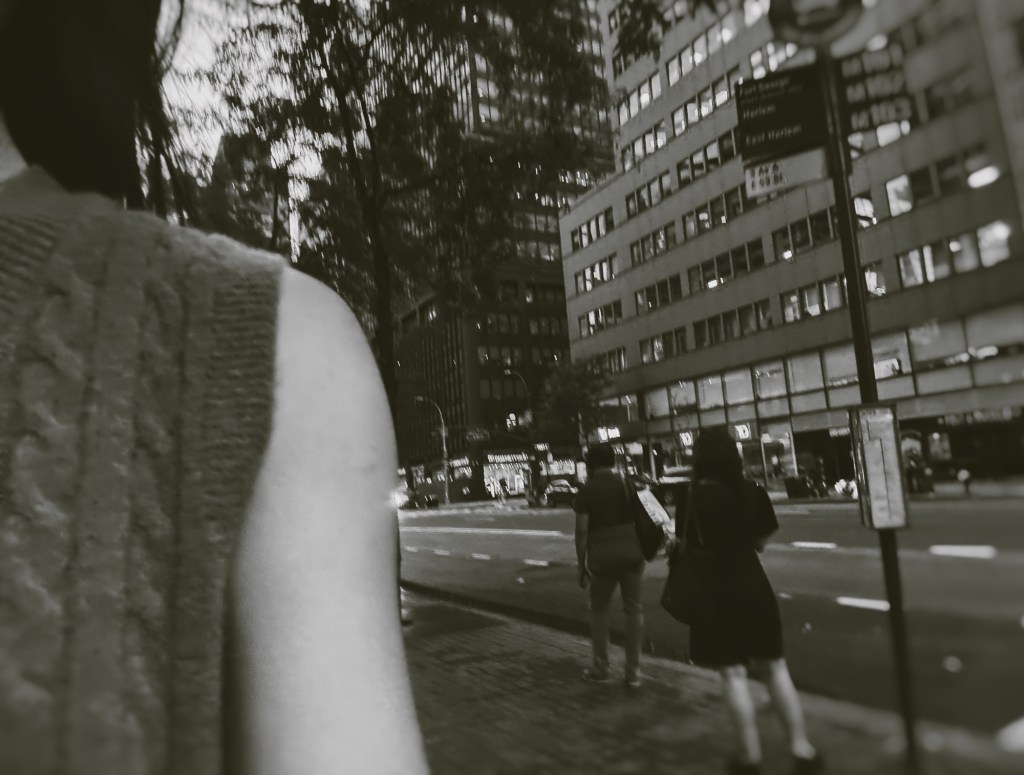
Oddly, and this really does freak me out, I too was on Lexington Avenue, on my way to meet someone the other day, at twilight nonetheless. And I too, having come out of the West, was feeling that it all must be a mirage. The way the last drops of light shot down the avenue as men in ties walked home with their briefcases and friends headed out for dinner. Couples held hands and overworked interns came out of the office for a breath of fresh air, ID cards clipped to their pants. Yellow taxi cabs honked and neon signs flickered.
The air carried the slightest, most imperceptible suggestion of fall and life felt suspended in the way it always does at the odd hour of twilight. That ephemeral window that belongs to neither day nor night, productivity nor rest. You are just a human in that hour, walking through a hazy world. You do feel that it must be a hallucination. You find yourself sitting on the train or walking down Lexington, waiting to wake up. You might even reach out and touch it—a tree, some brick, expecting it to burst at your fingertips like a bubble.
But it doesn’t. It never does.
You can be running home through rivers of rain or nearly getting killed by cars or suffocating in the subway tunnels as they announce yet another train delay and it is still the life that you choose.
Over and over again.


Click here to support a small artist with big dreams (me)
ABOUT SPINNING VISIONS
A space dedicated to documenting experience and exploring thought. Click here to read more.
GET ON THE LIST
Give your inbox something to look forward to.
 SPiNNiNG ViSiONS
Leave a Reply